



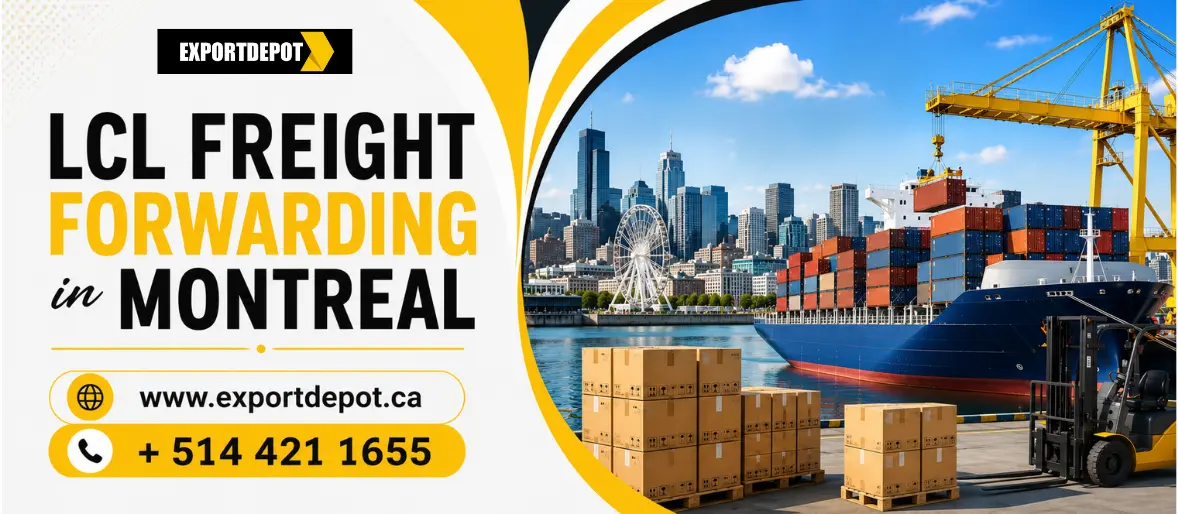
What to Expect from Port Delays And How LCL Freight Forwarding in Montreal Helps?
Port of Montreal delays are caused by labor disruptions, peak-season congestion, customs holds, and vessel-scheduling gaps. For shippers without a full container load, these delays hit harder because options feel limited. LCL freight forwarding in Montreal gives businesses a flexible, cost-controlled alternative that keeps cargo moving even when the port is under pressure.
Introduction
Anyone who has shipped goods through the Port of Montreal knows that timelines are not always guaranteed. One labor dispute can hold containers for days. A congestion spike during peak season pushes vessel schedules back without warning. And a customs documentation issue halts a shipment until the paperwork clears.
For businesses shipping smaller volumes, these disruptions are especially frustrating. Booking a full container is not practical when you only need a fraction of one. Waiting weeks for the port to stabilize is not an option when customers are expecting delivery.
LCL container shipping solutions exist precisely for situations like this. Understanding how port delays develop and how LCL freight forwarding helps manage them gives shippers a practical advantage before problems arise.
Why the Port of Montreal Creates Unique Challenges?
The Port of Montreal is located 1,600 kilometers inland from the Atlantic Ocean, along the St. Lawrence Seaway. That geography is both its strength and its vulnerability. Larger vessels cannot navigate the seaway, which limits capacity. Ice conditions in winter restrict vessel movement during certain months. When congestion or disruptions hit, cargo cannot simply be rerouted to a nearby major port the way it can in Halifax or Vancouver.
Shippers relying on regular ocean freight schedules through Montreal need to build contingency thinking into every shipment plan.
Let’s Discuss the Port Delays that LCL Freight Forwarding in Montreal Manages?
Labor Disruptions Catch Shippers Off Guard
The Port of Montreal has undergone many labor issues over the years. Strikes and work-to-rule situations have shut down their businesses just like that. When the company faces a strike, all vessels have to wait on the shore. There’s no possibility of moving the containers at the terminal. All shipments booked for vessels affected by the strike will be moved to other-line vessels as soon as they become available.
Amid these labor disturbances, Toronto freight forwarders can use different transport service providers. Besides, there are several other transport methods that forwarders can use in case of problems on the dockers’ part.
Peak Season Congestion Is Predictable but Still Painful
In the pre-holiday period, shipping volumes peak between August and October. This is when retailers begin to fill their inventories for the last quarter of the year. At this time, terminal space becomes scarce at Montreal. Shippers who wait until September to arrange Q4 cargo often find their preferred sailing dates gone.
LCL container shipping solutions in Canada handle peak-season pressure more efficiently than full-container bookings. Because LCL cargo is consolidated with other shipments, freight forwarders can move goods on the next available vessel. The per-unit cost stays manageable even when capacity is tight.
Customs Holds Are the Most Avoidable Delay
A missing field on a commercial invoice. An incorrect Harmonized System code. A packing list that does not match the cargo manifest. Each of these documentation errors triggers a customs hold, stopping a shipment cold until the issue is resolved. During busy periods in Montreal, resolution times stretch longer because customs officers are processing higher volumes.
Experienced LCL freight forwarding teams prepare and review documentation before cargo reaches the terminal. They know which fields customs officers scrutinize most closely, and which commodity classifications require additional certification.
Roll-On Roll-Off Shipping Adds Another Layer of Planning
Not all cargo moves in containers. Vehicles, heavy machinery, construction equipment, and oversized items often ship via roll-on roll-off vessels. Roll-on roll-off shipping Canada has its own scheduling windows, booking requirements, and documentation processes.
When port congestion hits, RoRo vessel schedules are affected just as container vessels are. Shippers moving vehicles or equipment alongside personal effects or commercial goods need a freight forwarder. Separating these into two uncoordinated bookings creates timeline mismatches that become expensive problems at the destination.
How LCL Forwarding Absorbs Port Disruptions?
The core advantage of LCL freight forwarding in Montreal is flexibility. A full-container-load shipper is locked into a single vessel, a single booking, and a single terminal slot. When that vessel is delayed, the shipper waits. An LCL shipper, by contrast, has cargo consolidated with other shipments across multiple sailings managed by a freight forwarder with relationships across the port network.
When one vessel is delayed, cargo can be moved to another consolidation. When one terminal is congested, an experienced forwarder finds an alternative routing. This flexibility does not eliminate delays; no service can. But it significantly reduces the duration of delays and their cost.
Common Port Delay Causes and Their Impact
| Delay Cause | Typical Duration | Impact on LCL Shippers |
| Labour Disputes | 3-14 days | Vessel holds affect all cargo types |
| Peak Season Congestion | 5-21 days | Berth availability drops significantly |
| Customs Documentation Issues | 2-10 days | A single error holds entire shipment |
| Vessel Schedule Changes | 3-7 days | Cascading delays across multiple ports |
| Equipment Shortages | 4-12 days | Container availability drops at the terminal. |
| Inspection and Examination | 2-8 days | Random or flagged cargo pulled for review |
FAQs
- What causes most delays at the Port of Montreal?
Labor disruptions, peak season congestion, customs documentation issues, and vessel schedule changes are the most common causes. Winter ice conditions on the St. Lawrence Seaway also affect vessel timing between November and April.
- How does LCL freight forwarding reduce the impact of delays?
LCL shipments are consolidated across multiple vessels and sailings. When one vessel is delayed, experienced freight forwarders can reroute cargo via alternative consolidations, significantly reducing the overall delay.
- What is the difference between LCL and FCL shipping?
LCL (Less than Container Load) means your cargo shares container space with other shippers’ goods. FCL (Full Container Load) means you book the entire container. LCL suits smaller volumes and offers more scheduling flexibility.
- How far in advance should I book LCL cargo from Montreal?
Three to four weeks is the minimum for standard periods. During peak season between August and October, five to six weeks is advisable to secure preferred sailing dates and consolidate space.
- What documentation is required for LCL shipments from Canada?
You typically need a commercial invoice, a packing list, a bill of lading, and the correct HS (Harmonized System) classification codes. Destination-specific requirements vary; some countries require additional certificates of origin or import permits.
Export Depot Keeps Your Cargo Moving
Shipping through Montreal means one has to be prepared to deal with some disturbance at the ports. What separates the businesses that can cope with delays is how they manage shipments.
Export Depot International provides LCL freight forwarding in Montreal that keeps cargo on schedule even when port conditions make that difficult. Our team handles LCL container shipping solutions in Canada, as well as roll-on/roll-off shipping services for vehicles and heavy equipment. We coordinate every stage from consolidation through customs clearance to final delivery.
Contact our Montreal team to request a freight quote and discuss the routing options that work best for your next shipment.

Related posts
How LCL Container Shipping Solutions in Canada Improves Supply Chain Efficiency?
Today’s fast-moving global economy relies heavily on an efficient supply chain

Don’t Make These Costly Mistakes in RoRo Shipping Canada to Europe
Transporting vehicles or heavy equipment from one country to another requires pl

RoRo Shipping Canada to Europe: FAQs Every Vehicle Owner Should Read
Shipping a vehicle overseas can be stressful. Many owners worry about costs, saf