



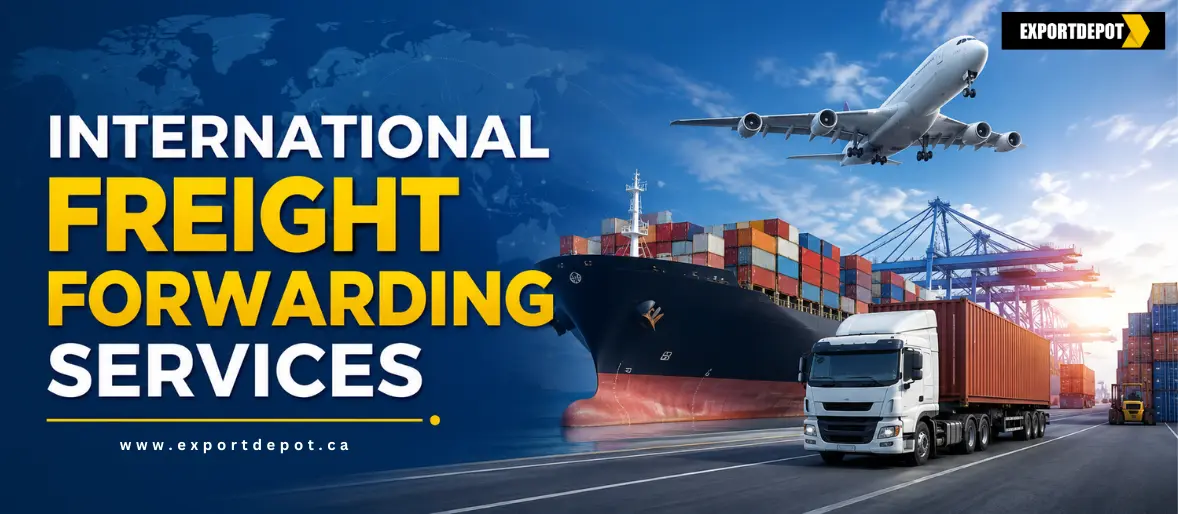
7 Costly Errors Businesses Make When Choosing International Freight Forwarding Services
Every shipment that crosses an international border carries financial risk. Choose the wrong partner, and that risk multiplies fast. Customs delays, surprise surcharges, damaged cargo, and missed delivery windows can cost your business far more than the freight bill itself. The global international freight forwarding services market reached USD 336 billion in 2026 and continues growing, which means hundreds of operators are competing for your business. Not all of them deserve it. At Export Depot, we help Canadian businesses navigate this landscape every day. So, let us walk you through the seven most costly mistakes businesses make when selecting a freight forwarding partner and exactly how to avoid every one of them.
7 International Freight Forwarding Services Errors to Avoid
1: Choosing on Price Alone
Low quotes are everywhere in the freight forwarding industry. However, a below-market price almost always signals a below-market service. Legitimate international freight forwarding services incur real operational costs, all of which contribute to the rate.
Operators who dramatically undercut the market skip these essentials. Furthermore, many budget forwarders use the CIF incoterms trap by quoting a low base rate and then adding destination handling fees, telex release charges, demurrage, and port storage costs. At that point, you do not have any leverage. You will pay, or your goods will remain at the port and incur additional fees each day.
Always request a fully itemized, all-in written quote. Compare what is included across every provider, not just the headline number.
2: Skipping License and Accreditation Verification
This is a non-negotiable check that too many businesses skip in the interest of speed. Every credible international freight forwarding services provider holds verifiable credentials. In Canada, look for CIFFA (Canadian International Freight Forwarders Association) membership.
For ocean freight, confirm an FMC Ocean Transportation Intermediary (OTI) license if shipping to or from the US. For air freight, confirm IATA cargo agent accreditation.
Transport Canada and the Canada Border Services Agency regulate international freight forwarders operating from Canada. Any forwarder unable or unwilling to provide their license numbers on request is already failing the most basic transparency test.
3: Ignoring Incoterms and Responsibility Boundaries
Incoterms are the universal language of international trade. They define exactly where seller responsibility ends, and buyer responsibility begins at every stage of a shipment. Not understanding them or choosing a forwarder that does not explain them clearly leads directly to unexpected costs and unresolved disputes.
A forwarder that does not explain which Incoterm governs your specific shipment is either inexperienced or intentionally vague. Both outcomes pose a danger to your supply chain. Always confirm the applicable Incoterm in writing before your cargo moves.
4: Overlooking Customs Documentation Accuracy
Customs errors are one of the leading causes of international shipment delays, and most of them are entirely preventable. Every international freight shipment requires an accurate commercial invoice, a packing list, a bill of lading or air waybill, a certificate of origin, and, in many cases, an HS Code classification.
A single incorrect HS Code can result in customs holds, duty miscalculations, and shipment release delays, costing your business both time and money. For international freight shipping, documentation errors can trigger CBSA review holds on the Canadian side and destination customs inspections, adding days or weeks to your delivery timeline.
A professional forwarder reviews your documentation before submission, not after a problem arises. Ask your prospective forwarder specifically how they handle HS Code verification and whether they provide customs brokerage in-house or outsource it to a third party.
5: Accepting Weak Cargo Insurance Terms
Cargo insurance is not a premium feature; it is a fundamental protection. Yet many businesses accept vague insurance terms without reading the actual coverage details. This is a serious and avoidable risk.
All Risks coverage under ICCA terms from a named, reputable underwriter is the gold standard for international cargo insurance. This coverage protects against total loss, partial damage, theft, and handling incidents throughout the transit journey.
By contrast, some forwarders offer Limited Liability coverage that compensates only based on cargo weight, not actual value. For high-value goods, this means a substantial loss is reimbursed at a fraction of the cargo’s value.
Always confirm the underwriter’s name, the coverage type, the insured value, and the claims procedure in writing before your cargo is loaded at the port of loading or at the origin airport.
6: Not Evaluating Multi-Modal Capability
Today’s global supply chains rarely move on a single transport mode. Your shipment might need ocean freight from Asia, air freight for an urgent component, cross-border trucking for Canadian customs clearance, and last-mile delivery to the final destination. Forwarders who specialize in only one mode force you to coordinate handoffs between multiple providers. This creates gaps where mistakes and delays occur.
A full-service international freight forwarding services partner handles FCL, LCL, international air freight, sea-air combinations, and intermodal transport from a single point of contact. The global freight forwarding market is moving toward integrated, multimodal solutions as businesses prioritize supply chain resilience over single-mode cost optimization. Your forwarder should reflect that direction.
Furthermore, verify their carrier relationships. A forwarder with strong ocean carrier contracts and established IATA air cargo allocations gives you genuine rate leverage. One relying solely on spot market bookings delivers inconsistent pricing and unpredictable access to capacity.
7: Ignoring Real-Time Tracking and Visibility
In 2026, real-time shipment visibility is a baseline expectation, not a premium service. The best international freight forwarding services provide digital tracking portals, automated milestone notifications, and direct access to bill of lading data throughout transit. Businesses that ship without this visibility are flying blind.
Poor tracking capability is also a symptom of a deeper operational weakness. Forwarders who cannot invest in freight management technology are typically operating at a scale and level of professionalism that will create problems for your supply chain.
Ask any prospective forwarder to demonstrate their tracking platform before you sign. Please confirm that you receive automated status updates at key milestones: cargo received, vessel departed, customs cleared, and out for delivery. If their answer is a weekly email update, that is not acceptable for freight shipping international in 2026.
Your Supply Chain Deserves Better Than a Costly Mistake
Every mistake in this guide is avoidable. Each one costs businesses real money, in demurrage fees, customs penalties, insurance shortfalls, or the operational disruption caused by shipments that arrive late, are damaged, or are held at the border.
At Export Depot, we build our entire service model around these seven standards. We serve Canadian businesses with end-to-end freight shipping international solutions, from CBSA export filings and air freight bookings to full ocean freight management and last-mile delivery.
Get your verified freight forwarding quote today at Export Depot, and make your next international shipment the smoothest one yet.

Related posts
Shipping Requirements in International Freight Shipping from Canada to The Middle East
International freight shipping is definitely a must for Canadian businesses seek
Shipping Maritime Transport – Ship Personal Belongings From Montreal to Israel
Do you need to send personal effects from Montreal to Israel? Maybe you’re

The Future of Local Shipping: What a Logistics Company Near Me Offers
Local Shipping is not just about moving things from Point A to Point B. It is al